
For overseas buyers purchasing from multiple Yiwu suppliers, the warehouse is more than a place where cartons wait before shipment. It is the point where different supplier deliveries become one manageable export order.
Goods may arrive on different dates, in different quantities, and with different packaging standards. Before those products can be consolidated, the warehouse needs to identify each shipment, verify the physical goods, record discrepancies, organize storage, and prepare the final cargo for dispatch.
Understanding this workflow helps buyers know what should happen between supplier delivery and international shipment. It also makes it easier to identify where quality, quantity, packaging, or documentation issues should be addressed.
A well-organized warehouse creates a control point between suppliers and international transportation.
A yiwu logistics agent can coordinate warehouse receiving, storage, consolidation, and shipment preparation so that goods purchased from different suppliers can be managed as one outbound order.
This is particularly useful when a buyer has several suppliers completing production at different times. Without proper receiving records, it can become difficult to determine which cartons have arrived, which products are missing, and whether the quantities match the purchase order.
Warehouse management therefore supports both logistics and procurement control.
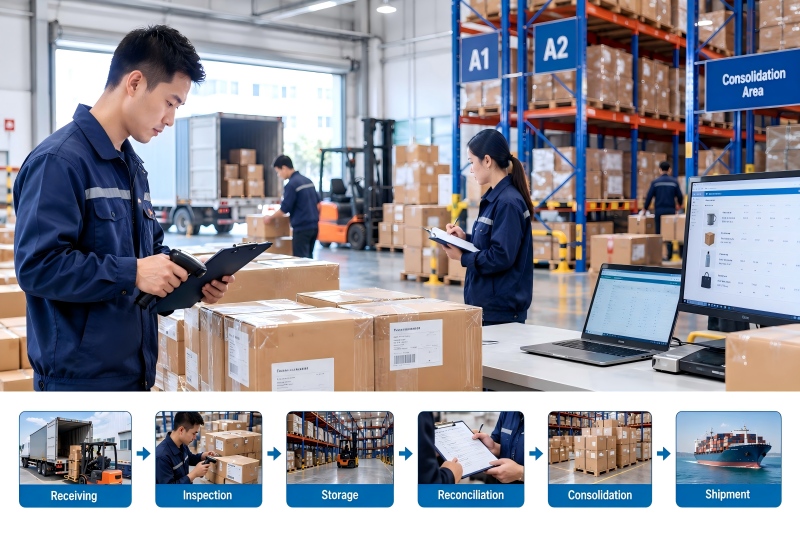
The first stage is shipment receiving.
When a supplier delivers goods, warehouse staff normally need to identify the shipment against available information such as supplier name, purchase order, carton marks, product reference, quantity, or delivery notice.
The warehouse may record:
Supplier information
Number of cartons
Product reference
Gross weight
Dimensions
Arrival date
Visible packaging condition
Purchase-order reference
The exact receiving procedure varies by warehouse, but the objective is the same: establish a traceable record for the goods.
After the shipment is identified, the warehouse can begin physical receiving.
Cartons should be counted and checked against the supplier's delivery information. If the supplier says that 50 cartons were delivered but only 48 are received, the discrepancy should be documented immediately.
Product-level information can also be associated with the shipment. Buyers sourcing a broad range of yiwu china market products benefit from having clear product references because similar-looking cartons can otherwise be difficult to distinguish.
Photographs can be useful when documenting external carton condition, labels, markings, or visible damage.
Once the shipment is received, the warehouse can verify the quantity and basic packaging condition.
This does not necessarily mean opening every individual product. The depth of inspection depends on the buyer's requirements, product category, previous supplier performance, and agreed quality-control procedure.
Possible checks include carton count, package labels, product quantity, carton dimensions, weight, and visible damage.
If an unexpected issue is found, the warehouse should record it and communicate it to the responsible buyer or sourcing team.
Warehouse receiving and quality inspection are related but should not be confused.
Receiving confirms that goods have arrived. Quality inspection evaluates whether the goods meet the agreed requirements.
Depending on the product, an inspection may examine dimensions, material, color, workmanship, functionality, labeling, packaging, or other specifications.
For repeat orders, the approved sample or specification sheet can provide an important reference.
If defects are discovered, the buyer may need to decide whether the supplier should repair, replace, rework, or accept the affected goods under an agreed commercial arrangement.
After receiving and inspection, goods may be placed into designated warehouse locations.
Inventory records should connect the physical cartons with the relevant supplier and order information. This is particularly important when multiple buyers or multiple purchase orders are being managed simultaneously.
A good warehouse record can show:
| Data | Purpose |
|---|---|
| Supplier | Identifies the source |
| Product reference | Prevents product confusion |
| Carton quantity | Tracks physical inventory |
| Arrival date | Establishes receiving timeline |
| Storage location | Supports retrieval |
| Inspection status | Shows whether goods are cleared |
| Shipment status | Shows whether goods are ready |
| Buyer/order reference | Connects goods to the commercial order |
The more products a buyer purchases, the more important this traceability becomes.
Consolidation is often delayed because different suppliers finish production at different times.
One supplier may deliver immediately while another needs several additional days. The warehouse therefore needs to maintain an updated record of what has arrived and what remains outstanding.
This information can help buyers decide whether to wait for the remaining goods or ship the completed portion separately.
The decision depends on freight cost, urgency, supplier timing, destination, and the buyer's inventory requirements.
Before consolidation, the sourcing team and warehouse should reconcile the order.
The purpose is to determine whether the physical goods correspond to the commercial order.
A reconciliation may compare:
Ordered quantity
Delivered quantity
Accepted quantity
Rejected quantity
Missing quantity
Supplier
Product specification
Packaging requirements
Inspection status
Shipping destination
For buyers using yiwu sourcing services, this stage can connect supplier-side purchasing records with warehouse-side receiving information.
The goal is to prevent a shipment from being dispatched before unresolved discrepancies are understood.
Once the required shipments have arrived and been cleared for dispatch, the warehouse can begin consolidation.
Goods from several suppliers may be grouped into one outbound shipment according to the buyer's instructions and transportation requirements.
The warehouse may determine how cartons should be arranged to make efficient use of available space while protecting fragile or sensitive goods.
Packaging decisions should consider product characteristics, carton strength, stacking requirements, moisture exposure, and transportation conditions.
Weight and dimensions influence transportation planning and freight costs.
For consolidated shipments, accurate measurements help logistics providers determine the appropriate transportation method and estimate charges.
Large but lightweight cargo may be affected by volumetric considerations, while dense cargo may be influenced more heavily by actual weight.
Buyers should therefore ensure that final shipment data is based on actual warehouse measurements where applicable rather than relying entirely on preliminary supplier estimates.
Damage should be documented as soon as it is discovered.
Photographs can establish the condition of the cartons or products at the time of warehouse receiving. The warehouse record should identify the affected shipment and supplier.
The buyer can then determine whether the issue appears to have occurred before delivery to the warehouse, during transportation, or during handling.
The exact responsibility depends on the transaction terms and circumstances. Documentation is important because it provides evidence for communication with the supplier or logistics provider.
For a multi-supplier order, every shipment should retain its identity until the reconciliation stage is complete.
A simple internal reference system can help. For example, Supplier A may be assigned SA-01, Supplier B SB-01, and so on. Individual product references can then be linked to the corresponding supplier.
This makes it easier to answer questions such as:
Which supplier delivered this carton?
Has this product passed inspection?
How many units have arrived?
Which supplier has not yet delivered?
Is the order ready for consolidation?
Without this structure, warehouse operations can become increasingly difficult as order volume grows.
Repacking may be useful when supplier packaging is unsuitable for international transportation or when several small shipments need to be consolidated.
However, repacking can add handling cost and time. Buyers should define their requirements before the goods arrive whenever possible.
For fragile products, additional protection may be necessary. For retail products, the buyer may also require specific labeling or packaging configurations.
The warehouse should record any additional handling performed so that the buyer understands the final shipment preparation process.
The warehouse is normally the bridge between supplier deliveries and outbound logistics.
After goods are received, inspected, reconciled, and consolidated, shipment information can be passed to the relevant logistics provider. The final package count, weight, dimensions, destination, and cargo information can then be used for transportation arrangements.
This creates a sequence:
Supplier delivery → Warehouse receiving → Inspection → Storage → Reconciliation → Consolidation → Shipment preparation → Export logistics
Each stage should produce enough information for the next stage to proceed without unnecessary uncertainty.
Before using a warehouse, buyers should clarify receiving procedures, storage fees, inspection options, consolidation rules, repacking charges, inventory records, photographic reporting, and shipment preparation.
They should also ask how the warehouse handles discrepancies.
A clear procedure might specify that quantity differences are reported immediately, damaged cartons are photographed, and goods are not dispatched until the buyer confirms how to handle unresolved issues.
Yes. Consolidated receiving from multiple suppliers is one of the practical reasons buyers use sourcing and warehouse services. Each supplier shipment should be separately identified and recorded.
The permitted or included storage period depends on the warehouse agreement. Buyers should confirm free-storage periods and additional storage charges before sending goods.
No. Receiving confirms that goods arrived. Quality inspection is a separate process and may require additional checks.
Potentially, depending on the supplier agreement, inspection findings, transportation arrangements, and commercial terms. The buyer should determine responsibility before deciding on a return or replacement.
Consolidation can allow multiple supplier orders to be managed as one outbound shipment. Whether it reduces overall logistics costs depends on cargo characteristics, destination, freight method, and other charges.
Useful information can include received quantities, carton count, weight, dimensions, inspection status, discrepancies, photographs, and current storage or shipment status.
A Yiwu warehouse plays an important role in converting multiple supplier deliveries into one organized international shipment. Receiving, identification, quantity checks, inspection, storage, reconciliation, and consolidation should be treated as connected stages rather than isolated warehouse tasks.
For overseas buyers, clear records are especially important when several suppliers are involved. By maintaining product references, supplier information, receiving records, inspection results, and final shipment data, buyers can gain better visibility before cargo leaves China.
 0086-579-85208991
  info@binachina.com
 English