
A successful Yiwu sourcing trip is rarely just a matter of booking a flight and walking into the market. Overseas buyers often need to coordinate airport pickup, accommodation, local transportation, interpreters, market appointments, supplier meetings, product research, samples, and follow-up discussions within a limited number of days.
The challenge is that Yiwu's wholesale markets are large and highly specialized. Without a clear itinerary, buyers can spend valuable time moving between unrelated market areas or visiting suppliers without having prepared the information needed for meaningful discussions.
A practical business travel plan should therefore connect transportation, accommodation, market visits, supplier meetings, and purchasing objectives into one schedule. The following checklist explains how overseas buyers can organize a productive Yiwu business trip.
Before leaving home, buyers should establish the purpose of the trip and convert it into a practical schedule.
A basic plan should identify the products to be sourced, target quantities, expected price range, preferred materials or specifications, packaging requirements, supplier meetings, and the number of days available in Yiwu.
Travel arrangements should then be built around those procurement priorities rather than the other way around. If a buyer needs to visit several market districts and meet suppliers outside the market, transportation time should be included from the beginning.
Preparing product images, specification sheets, target prices, business cards, company information, and purchasing requirements before departure can also make face-to-face meetings more productive.
Airport transfers and accommodation may seem like minor details, but they can affect the efficiency of the entire trip. International buyers arriving after a long journey may have limited time to navigate unfamiliar transportation systems before a scheduled market visit.
Professional business travel arrangements can help coordinate airport pickup, hotel arrangements, local transportation, and other practical elements of a business itinerary.
The hotel should ideally provide convenient access to the planned market areas and meeting locations. Buyers should also consider whether the hotel offers reliable internet access, suitable working space, early breakfast, luggage storage, and practical transportation options.
If the itinerary includes early-morning supplier meetings or late-day market visits, the accommodation location can make a noticeable difference to the amount of productive time available.
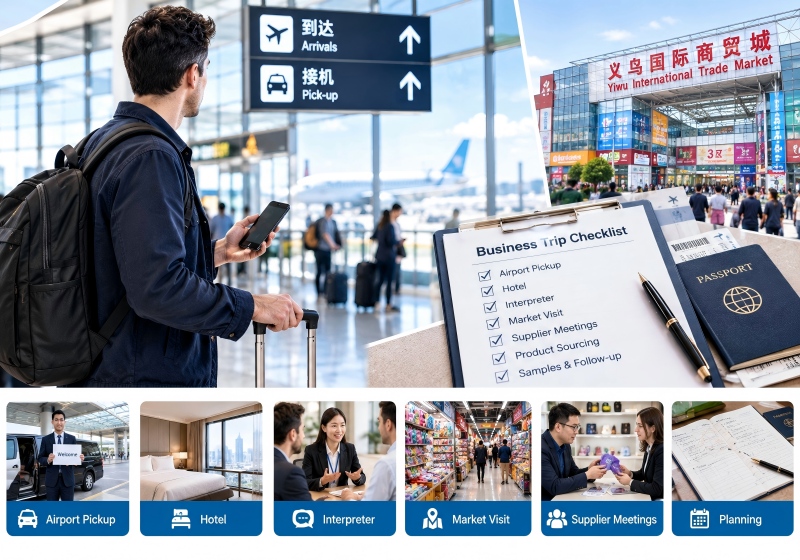
Before traveling, confirm the arrival airport, flight number, arrival time, passenger details, and pickup contact information.
International buyers should keep the name and telephone number of the local contact available offline in case mobile data or roaming services are temporarily unavailable.
It is also useful to have the hotel name and address available in both English and Chinese. Showing the Chinese address to a driver can make local transportation easier.
A simple arrival checklist can include:
| Item | Why It Matters |
|---|---|
| Passport and travel documents | Required for international travel and identification |
| Hotel confirmation | Provides the destination for airport transfer |
| Local contact | Useful if transportation changes |
| Flight details | Allows pickup timing to be coordinated |
| Product list | Helps begin sourcing immediately |
| Business cards | Useful for supplier meetings |
| Translation support | Helps with local communication |
The objective is to make the first few hours in Yiwu predictable rather than leaving important arrangements until arrival.
Yiwu's wholesale market environment is organized into different sections and product categories, so buyers should not treat the market as one undifferentiated shopping area.
A useful yiwu shopping guide can help buyers understand the market structure and prepare a route according to product categories.
Before visiting a market area, buyers should identify which products they actually need to investigate. If the trip involves several categories, group them geographically where possible.
For example, a buyer sourcing jewelry, household products, packaging items, and seasonal goods should create separate product lists and record supplier information systematically rather than relying on memory.
Market visits are more productive when every supplier conversation has a defined objective.
One common problem during a first Yiwu visit is spending too much time at individual booths without recording useful information.
Buyers should establish a simple supplier-recording system. Each supplier can be assigned a reference number, followed by information such as booth location, product category, contact details, quotation, MOQ, material, packaging, sample availability, and follow-up requirements.
Photos can also help buyers remember specific products after visiting dozens of suppliers.
However, buyers should obtain permission before taking photographs when necessary, particularly when photographing supplier displays, people, documents, or sensitive information.
The goal is to leave the market with structured procurement data rather than hundreds of unorganized photographs.
An interpreter can be useful when buyers need to discuss specifications, materials, packaging, quality requirements, production capabilities, payment terms, or customization.
Basic conversations may be possible in English at some supplier locations, but detailed commercial discussions can require more precise communication.
An interpreter should ideally understand business and product terminology rather than only providing literal translation. For technical products, buyers should prepare a glossary of important terms in advance.
The interpreter can also help clarify questions that might otherwise be misunderstood, especially when the buyer needs to discuss production tolerances, product materials, packaging instructions, or delivery requirements.
Supplier meetings should be arranged around the market itinerary, not added randomly throughout the day.
Before confirming a meeting, buyers should send suppliers a concise description of the products they want to discuss. This gives suppliers an opportunity to prepare samples, quotations, catalogues, or production information.
A useful meeting agenda may include:
Product specification review.
MOQ discussion.
Sample availability.
Price and quotation terms.
Customization possibilities.
Packaging requirements.
Production lead time.
Quality-control expectations.
Payment terms.
Next steps.
After the meeting, buyers should record decisions immediately. This reduces the possibility of confusing information from multiple suppliers later.
Product information is one of the most important parts of a sourcing trip.
Instead of showing a supplier a photograph and simply asking for a price, buyers should prepare as much information as possible. This may include dimensions, material, color, packaging, target quantity, application, reference images, branding requirements, and expected delivery schedule.
For buyers exploring a broad range of yiwu china market products, a structured product list makes it easier to compare suppliers and identify which products deserve further development.
A product sheet can contain the following:
| Field | Example Purpose |
|---|---|
| Product reference | Prevents confusion between similar products |
| Product image | Identifies the intended design |
| Material | Supports accurate quotation |
| Dimensions | Defines physical requirements |
| Color | Clarifies customization |
| Quantity | Helps suppliers calculate pricing |
| Packaging | Defines retail or shipping requirements |
| Target price | Supports negotiation |
| Certification | Identifies regulatory requirements |
| Sample status | Tracks development |
The more precise the initial requirement, the more meaningful supplier quotations are likely to be.
The first market session should usually focus on research rather than immediately placing large orders.
Buyers can compare product quality, supplier variety, pricing ranges, packaging options, and customization capabilities. This initial comparison can reveal whether the original purchasing assumptions are realistic.
Take structured notes and identify several candidate suppliers rather than selecting the first acceptable booth.
If a supplier offers a particularly interesting product, request a sample or quotation and record the supplier's contact details before moving to the next location.
This creates a shortlist for deeper evaluation after the market research phase.
Samples can quickly become difficult to organize when buyers visit many suppliers.
Each sample should be linked to a supplier reference and product reference. Buyers should record the supplier name, booth location, quotation, product specifications, and any special comments.
For larger sourcing projects, photographs of the sample and packaging can be stored together with the supplier information.
Buyers should also distinguish between a showroom sample and a production sample. A product displayed at a market booth may not necessarily represent the exact product that will be manufactured for a large order.
Before returning home, review all important supplier information.
Confirm that you have the contact details for shortlisted suppliers, product quotations, sample information, agreed specifications, estimated production times, and any follow-up actions.
If suppliers promised additional documents or revised quotations, request them before departure where practical.
It is also useful to summarize the next steps for each supplier. For example:
| Supplier | Product | Status | Next Action |
|---|---|---|---|
| Supplier A | Product X | Sample received | Compare quality |
| Supplier B | Product Y | Quotation pending | Request final price |
| Supplier C | Product Z | Customization discussed | Confirm specification |
| Supplier D | Product W | Not suitable | No follow-up |
This simple record can make post-trip sourcing much more efficient.
A local sourcing partner can connect the travel side of the trip with the purchasing side.
Instead of treating airport pickup, market visits, interpretation, supplier meetings, product sourcing, and follow-up as separate activities, a local agent can coordinate them around the buyer's procurement objectives.
This can be particularly useful for first-time visitors or buyers with a large product list. The agent can also help communicate with suppliers after the buyer returns home, allowing the sourcing process to continue after the physical trip has ended.
The appropriate length depends on the number of product categories, supplier meetings, and market areas involved. A focused trip can be relatively short, while buyers researching many categories may need several days.
It depends on the project. Market research first can help buyers understand product variety and pricing before committing to supplier meetings.
Not every buyer does, but an interpreter can be useful when discussing detailed product specifications, customization, quality requirements, and commercial terms.
A convenient location should be selected based on the buyer's market itinerary and supplier meetings. Transportation time should be considered alongside hotel price and amenities.
If the buyer wants suppliers to quote or reproduce an existing product, bringing a physical reference sample can be extremely useful. Photographs and detailed specifications can supplement it.
Follow up with shortlisted suppliers, compare quotations, evaluate samples, confirm specifications, and decide which suppliers should proceed to the next stage.
A productive Yiwu business trip requires more than a flight booking and a list of markets. Airport pickup, accommodation, transportation, interpretation, market routing, supplier meetings, product information, and post-trip follow-up should work together as one procurement plan.
By preparing product requirements before arrival and recording supplier information systematically during the visit, overseas buyers can turn a short business trip into a more structured sourcing project. Local coordination can further reduce the time spent on logistics and allow buyers to focus on evaluating products and suppliers.
 0086-579-85208991
  info@binachina.com
 English